
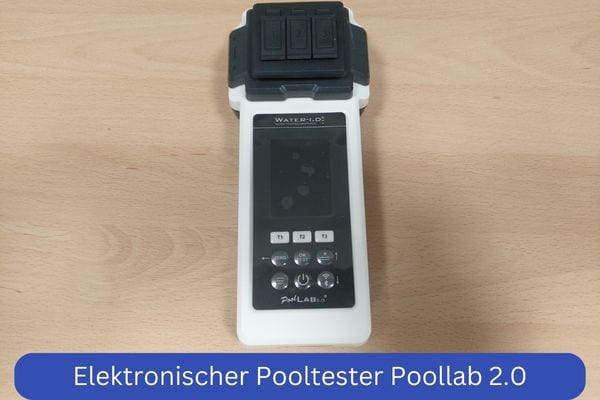
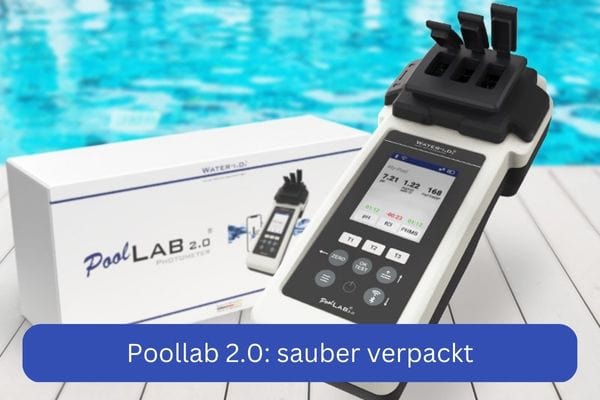


Electronic pool tester PoolLab 2.0 – Where guesswork meets precision
Choose options
If you hate test strips (comparing colors is gambling). If you misjudge the pH level (too much increaser = pH shoots up). If you want to know what's REALLY in your water (don't guess – measure). If you want to guarantee crystal-clear water (instead of hoping).
They have a pool. They test the water with test strips (€5 for 50 strips). The problem:
Problem #1: Test strips are inaccurate (color comparison = gambling)
Test strips show color (yellow-orange-red for pH, white-pink-purple for chlorine). You have to compare the color to the color scale on the container. Problem: Colors are subjective (is that "light pink" or "pink"? pH 7.2 or 7.4?). Colors look different under different lighting conditions (sun, shade, evening) → you'll get a different reading each time . Accuracy: ±0.2-0.4 pH (huge variation).
Problem #2: Incorrect dosage = pool crashes.
You measure pH 7.0 with test strips (too low, target 7.2-7.4). You add pH increaser → guess the amount (it's not indicated on the test strips – "a little pH increase" = how much?). You add too much → pH shoots up to 7.8 (too high) → you have to add pH decreaser → pH drops to 6.8 → a ping-pong game (constantly adjusting up and down). You're getting desperate.
Problem #3: Important parameters are missing (cyanuric acid, phosphate, copper)
Standard test strips measure pH, chlorine, and alkalinity (3 parameters). Important parameters are missing: cyanuric acid (stabilizes chlorine – too much = chlorine is ineffective), phosphate (algae food – too much = algae grow despite chlorine), and copper (from the heat pump – too much = green water). If you don't measure these parameters , the pool will become unbalanced, and you won't know why .
Problem #4: No documentation = You forget values
Today you measure pH 7.2, chlorine 1.5 mg/L. Tomorrow: What were the readings yesterday? You don't know (it wasn't recorded). You ca n't identify any trends (is the pH constantly rising? Is the chlorine decreasing every day? Do you need to top up the cyanuric acid?). You're driving blind.
There is a solution. One that solves all four problems simultaneously – with laboratory precision.
The PoolLab 2.0 – the electronic photometer (digital water tester with Bluetooth/WiFi). Its special features: precise measurement (±0.02 pH – 10x more accurate than test strips), 24 measurable parameters (pH, chlorine, cyanuric acid, phosphate, copper, alkalinity, water hardness, etc.), automatic dosing recommendation (the app says: "Add 50g of pH-Plus" – no guesswork), cloud synchronization (all measurements are saved – you can see trends over months).
What you will receive:
- Precision ±0.02 pH – 10x more accurate than test strips (don't guess – know)
- 24 parameters measurable – pH, chlorine (free/total), bromine, cyanuric acid, phosphate, copper, alkalinity, water hardness, iron, aluminum, urea, and more
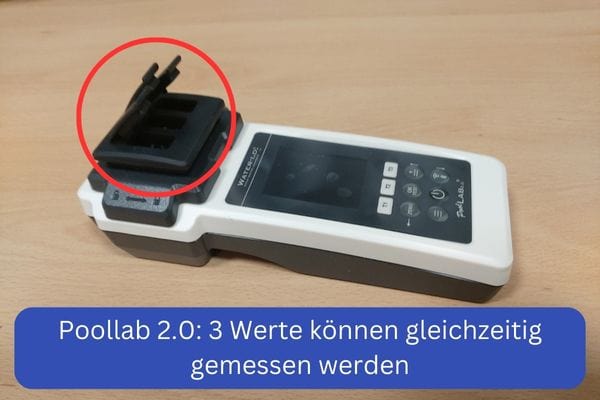
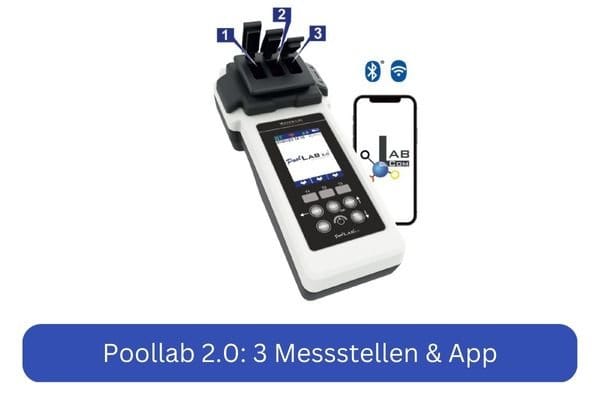
- Measure 3 parameters in parallel – triple cuvette (pH + chlorine + alkalinity simultaneously – saves time)
- Automatic dosage recommendation – app calculates: "Add 50g pH-Plus for a 32m³ pool" (precise, no ping-pong dosing)
- Bluetooth + WiFi – Measurement data automatically saved to app/cloud (you can see trends)
- IP68 waterproof – immerse directly in pool (take a sample without a separate cup)
- Large color display – clear display (readable even in sunlight)
- Compatible with tablets/drops/powders – DPD tablets, photometer reagents
- LSI Index Calculation – Langelier Saturation Index (Predicting Limescale Formation)
- Free app/software/cloud – no subscription costs, free for life.
The result: You measure pH 7.18 (instead of "somewhere between 7.0 and 7.4") → App says "Add 35g of pH Plus" → You add exactly 35g → pH is 7.30 (perfect, within the target range). No ping-pong dosing. No frustration. Precision.
Saturday morning, 10:00 AM. The pool is cloudy (although the chlorine level is "okay" according to the test strips). Using test strips: Chlorine = "pink" (1-3 mg/L? No idea exactly). pH = "orange" (7.2-7.6? Unclear). You guess: Maybe too little chlorine? Add 100g of chlorine → water remains cloudy. Why? Cyanuric acid too high (80 mg/L – chlorine isn't working) → but the test strips don't measure that . With PoolLab 2.0: Measurements: Chlorine 1.8 mg/L (precise), pH 7.42 (precise), cyanuric acid 82 mg/L (much too high – cause found!). The app says: "Drain the water + refill (a 30% water change lowers cyanuric acid to 57 mg/L)." You do this → water clears up . Problem solved – because you knew the CAUSE.
The 5 most important advantages at a glance:
- Precision ±0.02 pH = 10x more accurate than test strips : Test strips: ±0.2-0.4 pH (huge fluctuation), PoolLab 2.0: ±0.02 pH (laboratory precision). You know EXACTLY what's in the water (no guessing), no incorrect dosing (no more pH ping-pong), Crystal Clear purists are happy.
- 24 measurable parameters = complete water analysis : pH, chlorine (free/total), bromine, cyanuric acid, phosphate (algae food), copper (from heat pump), alkalinity, water hardness (calcium/total), iron, aluminum, urea, nitrate, ammonium, PHMB, chlorine dioxide, ozone, and more. Standard test strips: only 3-5 parameters (rest unknown).
- Automatic dosage recommendation = no guesswork : The app calculates a precise dose ("Add 35g of pH Plus for your 32 m³ pool"), based on measured values and pool volume, preventing over- or under-dosing, saving chemicals (€50-100/year), and saving time (no trial and error).
- Cloud synchronization = Trend detection : All measurements are automatically saved (Bluetooth/WiFi), you can see the trend over weeks/months (is pH constantly rising? Is chlorine decreasing?), detect problems early (before the pool becomes unbalanced), print reports (for warranty, pool builder, your own documentation)
- IP68 waterproof + 3-compartment cuvette = fast measurement : Immerse directly into the pool (take sample without a separate cup), measure 3 parameters simultaneously (pH + chlorine + alkalinity at the same time – 3 min instead of 15 min), zero calibration only required once (not before every measurement), saves 12 min/week = 10 hours/year
Who is this pool tester ideally suited for?
Reality check : The PoolLab 2.0 is for Crystal Clear purists + chemistry optimizers + problem solvers who want precise measurement + complete water analysis + dosing safety – and are willing to invest in professional equipment (more expensive than test strips, but it pays for itself).
✓ "Crystal Clear purists" – people who want to KNOW (not guess)
You're a perfectionist. Test strips = guesswork ("is the pH 7.2 or 7.4?"). PoolLab 2.0 shows: pH 7.23 (precise, digital, unambiguous). You know EXACTLY what's in the water → no uncertainty → you can correct precisely → crystal-clear water guaranteed (not just hoped for).
✓ People with problem pools (water is cloudy/green – despite "correct" chlorine)
Your pool is cloudy (even though the test strip says "chlorine okay, pH okay"). Problem: The test strip doesn't measure cyanuric acid/phosphate/copper (hidden causes). PoolLab 2.0 measures 24 parameters → finds the hidden cause (e.g., cyanuric acid 80 mg/L = chlorine ineffective) → problem solved (because the cause is known).
✓ People who want to reduce chemical costs (overdosing = waste of money)
You're adding too much pH-Plus/chlorine/algaecide (because test strips are inaccurate = you're adding more "just to be safe"). Overdosing costs €50-100/year wasted. PoolLab 2.0 + App: Precise dosage recommendation ("Add exactly 35g of pH-Plus") → no overdosing → saves €50-100/year → pays for itself in 3-4 years .
✓ People with saltwater/mineral pools (who need to measure cyanuric acid)
Saltwater pools with salt electrolysis produce stabilized chlorine (which contains cyanuric acid). Problem: Cyanuric acid accumulates over time (20 → 40 → 60 → 80 mg/L) → above 60 mg/L, chlorine becomes less effective → the pool becomes cloudy. Standard test strips do NOT measure cyanuric acid. PoolLab 2.0 measures cyanuric acid → you know when a water change is necessary (before the pool becomes unbalanced).
✓ People with heat pumps (who need to measure copper)
The heat pump has a copper heat exchanger → copper dissolves slowly (0.1-0.5 mg/L over months) → at >0.3 mg/L: water turns green (copper oxidizes). Standard test strips do NOT measure copper. PoolLab 2.0 measures copper → you detect the problem early (before the water turns green) → you can add a copper binder.
✓ People who want to identify trends (pH is constantly rising – why?)
You measure pH every week → pH is always 7.6-7.8 (too high) → You add pH reducer → next week it's 7.8 again. Why is the pH rising? Test strips don't tell you. PoolLab 2.0 + Cloud: You see the trend over months (pH rises steadily → cause: alkalinity too high) → You lower the alkalinity → pH remains stable (problem solved – because you recognized the trend).
✓ Pool professionals/service technicians (who look after multiple pools)
They manage 5-10 pools (customers, vacation homes). With test strips: You measure Pool A → note the values on paper → forget what Pool B had last week. With PoolLab 2.0 + Cloud: You measure Pool A → values are automatically saved (cloud, "Pool A" account) → next week: the app shows the history → you immediately see what has changed → more efficient maintenance.
✓ People with premium pools (who appreciate attention to detail)
Your pool is premium (heat pump €5,000, LED lighting €1,000, counter-current system €3,000). You want premium water quality (Crystal Clear, always perfect). Test strips = cheap solution (not suitable for a premium pool). PoolLab 2.0 = professional solution (laboratory precision, 24 parameters) → suitable for a premium system .
Product description: When photometers meet Bluetooth
The concept: Photometer = light measurement instead of color comparison
Test strips work by color comparison: Reagent on strip reacts with water → changes color → you compare color with scale → subjective, inaccurate (±0.2-0.4 pH).
Photometers (like PoolLab 2.0) work by measuring light: Reagent in cuvette reacts with water → changes color → light sensor measures color intensity (objectively, precisely) → digital display (±0.02 pH).
Difference: Photometer eliminates human error (subjective color perception) → 10x more accurate .
Precision ±0.02 pH – Laboratory quality for home use
Test strip accuracy: ±0.2-0.4 pH (at pH 7.2 you measure 6.8-7.6 – huge fluctuation).
PoolLab 2.0 accuracy: ±0.02 pH (at pH 7.2 you measure 7.18-7.22 – minimal fluctuation).
Difference: PoolLab is 10-20x more accurate .
Why is this important?
Target pH range: 7.2-7.4 (optimal for chlorine effectiveness and skin compatibility). Tolerance: ±0.2 pH (7.0-7.6 = acceptable, 6.8 or 7.8 = problem).
Using test strips (±0.4 pH): You measure "7.2" → the actual pH could be 6.8-7.6 → you don't know if correction is needed → you guess .
With PoolLab (±0.02 pH): You measure "7.18" → actual pH is 7.16-7.20 → you know exactly: slightly too low → app says: "Add 15g pH-Plus" → pH becomes 7.30 → perfect.
24 parameters measurable – Complete water analysis
Standard test strips: 3-5 parameters (pH, chlorine, alkalinity – sometimes hardness, cyanuric acid).
PoolLab 2.0: 24 parameters:
Basic parameters (standard):
- pH (acid/base ratio)
- Chlorine-free (active chlorine, disinfected)
- Total chlorine (free + bound)
- Chloramines (bound chlorine – smells, does not disinfect)
- Bromine (alternative to chlorine)
- Alkalinity (buffer capacity, stabilizes pH)
Stabilizers + inhibitors:
- Cyanuric acid (stabilizes chlorine – too much = chlorine is ineffective)
- PHMB (chlorine-free disinfectant)
- QUAT (algicide active ingredient)
Algae food + impurities:
- Phosphate (algae food – too much = algae grow despite chlorine)
- Nitrate (algae food)
- Urea (from sweat/urine – reduces the effect of chlorine)
- Ammonium (from organic material)
Metals (from pipes/heat pumps):
- Copper (from heat pump – too much = green water)
- Iron (from pipes – too much = brown water)
- Aluminum (from flocculants)
- zinc
Water hardness:
- Total hardness (calcium + magnesium)
- Calcium hardness (limescale formation)
Other:
- sulfate
- potassium
- Ozone (alternative disinfection)
- Chlorine dioxide (alternative disinfection)
- Hydrogen peroxide (active oxygen)
Why so many parameters are important:
Example of a problem pool: Water is cloudy (despite "correct" chlorine + pH according to test strips).
Using test strips: You only see pH/chlorine → both "okay" → cause unknown → you despair.
With PoolLab 2.0: You measure all parameters → find: Phosphate 500 µg/L (much too high – algae food) → cause found → you add phosphate remover → water becomes clear .
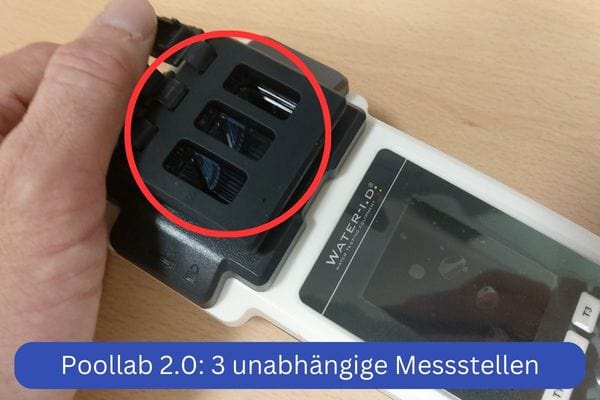
Triple cuvette – measure 3 parameters in parallel
Standard photometer: 1 cuvette → measure pH → rinse → measure chlorine → rinse → measure alkalinity → 15 min total .
PoolLab 2.0: 3 cuvettes (side by side, permanently installed) → They measure pH + chlorine + alkalinity simultaneously → 3 min total (5x faster).
How does that work?
The triple cuvette has 3 separate chambers (10 ml each) → You fill:
- Chamber 1: Sample + pH reagent
- Chamber 2: Sample + chlorine reagent (DPD tablet)
- Chamber 3: Sample + alkalinity reagent
PoolLab measures all 3 chambers in parallel (3 light sensors) → result after 1 min (all 3 parameters simultaneously).
Advantage: Saves time (3 min instead of 15 min) + easier (only one dip required).
Automatic dosage recommendation – the app calculates for you
Using test strips: You measure pH 7.0 (too low, target 7.3) → You guess: "Maybe 50g of pH Plus?" → You add 50g → pH becomes 7.1 (still too low) → You add another 50g → pH becomes 7.8 (too high) → Ping-pong game .
With PoolLab 2.0 + App:
- They measure pH 7.02 (precisely)
- App asks: "Pool volume?" → You: "32 m³"
- App asks: "Target pH?" → You: "7.3"
- App calculates: "Add 35g of pH-Plus (sodium carbonate)"
- They give exactly 35g
- pH reaches 7.28 → perfect, within the target range
No ping-pong dosing. No guesswork. Precision.
App takes into account:
- Current value (pH 7.02)
- Target value (pH 7.3)
- Pool volume (32 m³)
- Chemical type (pH-Plus = sodium carbonate, different strength than sodium bicarbonate)
- Alkalinity (buffers pH → affects dose)
The result: Precise dose (accurate to 5g) → no over-/under-dosing → saves chemicals (€50-100/year).
Cloud synchronization – identifying trends, anticipating problems
Using test strips: You measure pH 7.2 today → tomorrow you forget the value → no documentation → you drive blind .
With PoolLab 2.0 + Cloud:
Automatic storage: Every measurement is automatically saved (Bluetooth/WiFi → App → Cloud) → You don't need to write anything down.
Trend charts: App shows pH trends over weeks/months (graph) → You can see trends:
Example problem: pH rises constantly (0.1 higher every week – 7.2 → 7.3 → 7.4 → 7.5).
Using test strips: You won't notice it (no documentation) → only when pH is 7.8 (pool is cloudy) will you notice the problem.
With PoolLab Cloud: You see the trend immediately (after 3 weeks – pH rises linearly) → You analyze the cause (alkalinity too high) → You lower the alkalinity → pH remains stable (problem solved before the pool crashes).
Other cloud features:
- Manage multiple pools (e.g., pool + hot tub – separate accounts)
- Print reports (for warranty, pool builder, own documentation)
- Alarm function (if parameters are outside the target range → push notification)
- Device synchronization (PoolLab → App on smartphone → App on tablet → all data identical)
IP68 waterproof – Can be submerged directly in the pool
Standard photometer: Not waterproof → You have to take a sample (dip beaker in pool, take sample, go to lab/technical room, fill sample into cuvette) → cumbersome .
PoolLab 2.0: IP68 waterproof (can be submerged up to 1m deep for 30 minutes) → You immerse PoolLab directly in the pool → 3-compartment cuvette fills automatically → done (1 step instead of 5).
Advantage: Saves time (2 min instead of 5 min) + simpler (no separate cup needed).
Plus: More robust (falls into water? No problem – waterproof).
Large color display – readable even in sunlight
Old photometers: Small LCD display (black and white) → not readable in sunlight (reflection).
PoolLab 2.0: Large color display (2.8 inch, TFT) → readable even in direct sunlight → You can measure directly at the pool (do not go into the technical room).
Plus: Intuitive operation (touch-like buttons, colored icons) → also understandable for non-technical users .
LSI index calculation – predicting calcification
Langelier Saturation Index (LSI) = mathematical formula that predicts whether water forms limescale (crusty), dissolves limescale (aggressive), or is balanced .
LSI takes into account: pH, alkalinity, calcium hardness, water temperature, total hardness.
LSI value:
- LSI = 0: Balanced (ideal)
- LSI > 0: Limescale-forming (water is supersaturated → limescale deposits → white crusts on walls/pipes)
- LSI < 0: Limescale-dissolving (water is aggressive → dissolves limescale from concrete/joints → damage)
The PoolLab app automatically calculates LSI (after measuring all parameters) → You see: "LSI = +0.3 (slightly calcifying)" → You can take preventative measures (slightly lower pH, lower calcium hardness) → no limescale deposits .
Technical specifications at a glance
PoolLab 2.0 Photometer
Measurement technology:
- Type: Electronic photometer (light measurement)
- Cuvettes: Triple cuvette (10 ml per chamber, replaceable)
- Measurable parameters: 24 (see list above)
- Accuracy: ±0.02 pH (10x more accurate than test strips)
- Measuring range: Varies depending on the parameter (e.g. pH 6.5-8.5, chlorine 0-10 mg/L)
Connectivity:
- Bluetooth 4.0 (range approx. 10m)
- WiFi 2.4 GHz (automatic cloud synchronization)
- Free app (iOS/Android)
- Free software (Windows/Mac)
- Free cloud service (for life)
Housing:
- Protection class: IP68 (waterproof to a depth of 1m, 30 min)
- Material: Robust plastic
- Display: 2.8-inch TFT color display
- Operation: Touch-like buttons
Power supply:
- 3x AA batteries (included)
- Battery life: approx. 1,000 measurements
Dimensions & Weight:
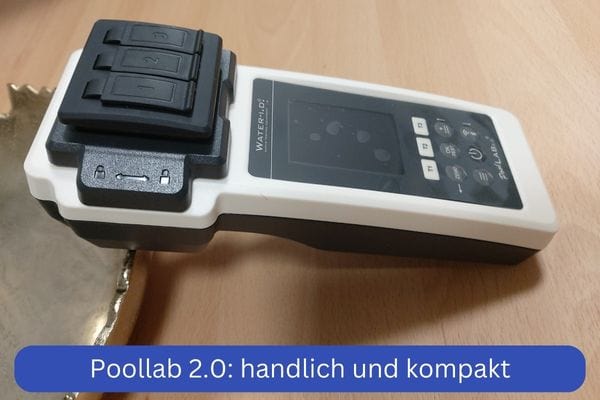
- Size: approx. 200 x 100 x 50 mm (compact)
- Weight: approx. 300g (with batteries)
Compatibility:
- Reagents: DPD tablets, photometer drops, photometer powder
- Standardized (ISO compliant)
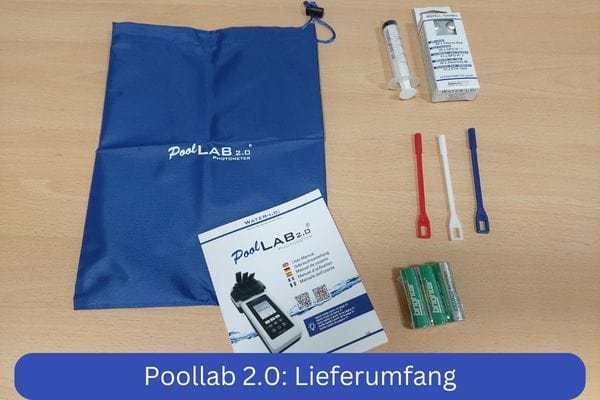
Scope of delivery
✓ PoolLab 2.0 Photometer (with Bluetooth + WiFi, IP68)
✓ Triple cuvette (interchangeable, permanently installed)
✓ Light shield cap (protects sensors)
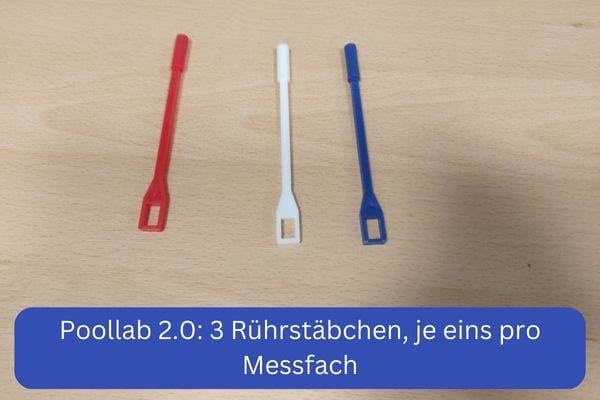
✓ 3x Stirring stick (plastic, for mixing)
✓ 1 x 10ml syringe (for precise dosing)
✓ 3x AA batteries
✓ User manual (German)
✓ Storage bag (transport)
✓ Free PoolLab software (download)
✓ Free PoolLab App (iOS/Android)
✓ Free cloud service (for life)
Not included in the delivery:
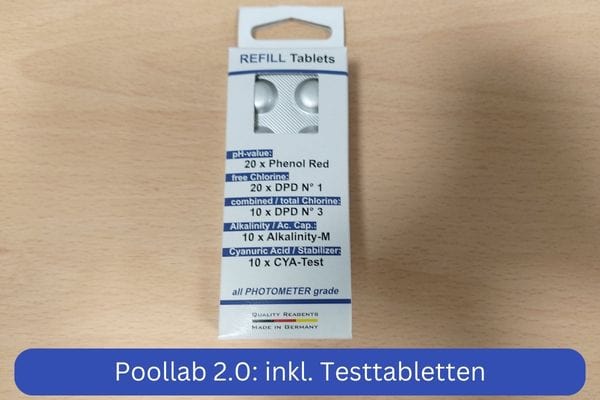
- Reagents (DPD tablets, photometer reagents – order separately depending on the parameter)
- Pool chemicals (pH-Plus, chlorine, etc.)
Why people choose PoolLab 2.0
"Sabine H. says: **We've had the PoolLab for several years now and are extremely happy with it. I always thought those test strips were a gamble. You never know how much levour and sipirinant you need to add.** And with the PoolLab, you can also measure the important cyanuric acid level. We're very satisfied and have always had clear water."
"Test strips: pH 'somewhere 7.2-7.6' (unclear). PoolLab: pH 7.23 (precise, digital). I know EXACTLY what's in the water. No more guesswork."
– Mr. K., 52 years old, Crystal Clear purist
"My pool was cloudy (despite 'correct' chlorine levels according to the test strips). PoolLab showed: cyanuric acid 78 mg/L (much too high – chlorine is ineffective). 30% water change → water clear. Problem solved – because I knew the cause."
– Ms. M., 48 years old, Problem Pool
"The app says: 'Add 42g of pH-Plus'. I add exactly 42g. The pH becomes perfect. Before: I would guess 'maybe 50g?' → ping-pong dosing. Now: precision."
– Mr. S., 55 years old, chemical optimizer
"The cloud stores all measurement data. I see: pH has been rising steadily for 4 weeks (7.2 → 7.3 → 7.4 → 7.5). Cause: Alkalinity too high. I lower alkalinity → pH remains stable. Trend identified = problem solved."
– Ms. L., 50 years old, data nerd
"IP68 waterproof: I submerge PoolLab directly in the pool (cuvette fills up). No separate cup. 2 minutes instead of 5 minutes. Easier."
– Mr. T., 58 years old, efficiency guru
Frequently Asked Questions – Honest Answers
Q: Is PoolLab 2.0 worth it (more expensive than test strips)?
A: Yes (in the long term). Costs: PoolLab (€300-400) vs. test strips (€30/year x 10 years = €300) = similar costs . But: PoolLab saves €50-100/year on chemicals (precise dosing = no overdosing) = pays for itself in 3-4 years . Plus: 10x more accurate, 24 parameters, dosing recommendation, cloud access.
Q: Do I still need reagents (or does PoolLab measure without them)?
A: Yes, reagents are needed. PoolLab is a photometer (measures color intensity after reagent addition). You will need: DPD tablets (for chlorine), photometer reagents (for pH, alkalinity, etc.). Cost: €50-100/year for reagents (similar to test strips).
Q: How often do I need to test the pool?
A: 2-3 times per week (under normal operating conditions). More often if: after rain (lots of water added), after a pool party (many bathers), in case of algae problems, or during temperature changes.
Q: Can I use PoolLab with other reagents (not the original)?
A: Yes (mostly). PoolLab is standardized (ISO-compliant) → works with most DPD tablets/photometer reagents. However: Best results with original reagents (calibrated on PoolLab).
Q: How long do batteries last?
A: Approximately 1,000 measurements (with 3 AA batteries). At 2-3 measurements/week = 6-10 years battery life (very long).
Q: Does the app work offline (without internet)?
A: Yes (Bluetooth works offline). Measurement data is stored on your smartphone and synchronized later (when WiFi is available). Cloud sync requires an internet connection (but is not strictly necessary for measurement).
Q: Can I manage multiple pools (pool + hot tub)?
A: Yes (the app has "measurement source accounts"). You create: "Pool 32 m³" + "Whirlpool 2 m³" → when measuring, select account → values are saved separately → no confusion.
Q: How do I clean a triple cuvette?
A: After each measurement: Rinse the cuvette with clean water (3 times) → done. Every 10-20 measurements: Wash with distilled water and mild cleaner (no scratches!) → let it dry.
Now ensure precision + 24 parameters + dosing reliability
If you're tired of guessing with test strips. If you want to KNOW what's in your water (not guess). If you want to find the root causes of problems (cyanuric acid, phosphate, copper). If you want to guarantee crystal-clear water.
The PoolLab 2.0 is built for crystal-clear purists, chemistry optimizers, and problem solvers who want laboratory precision , complete water analysis , and automatic dosing recommendations – and are willing to invest in professional equipment.
Precision ±0.02 pH. 24 parameters. Cloud synchronization.
✓ Precision ±0.02 pH (10x more accurate than test strips)
✓ 24 parameters measurable (pH, chlorine, cyanuric acid, phosphate, copper, etc.)
✓ Automatic dosage recommendation (saves €50-100/year on chemicals)
✓ Cloud synchronization (identify trends, predict problems)
✓ IP68 waterproof (can be immersed directly in a pool)
✓ Triple cuvette (3 parameters in parallel – 5x faster)
✓ Large color display (readable even in sunlight)
✓ LSI index calculation (predicting limescale buildup)
✓ Free app/software/cloud (lifetime)
Or would it be better to seek advice first?
✓ Non-binding
✓ PoolLab vs. test strips?
✓ Which reagents do you need?
✓ Pool chemistry training
Measure. Know. Dose. Perfect.
The PoolLab 2.0 is not "a tester." It's your precision instrument . Your chemical insurance. Your problem-solving machine. Photometer technology like a laboratory. Cloud intelligence like a smart home. The brain of your pool chemistry – precise, comprehensive, and absolutely reliable.
Your clear water. Your safety. Your PoolLab 2.0.
Test strips are a gamble. Comparing colors (is pH 7.2 or 7.4? Unclear). Incorrect dosage (too much pH-Plus → ping-pong effect). Important parameters are missing (cyanuric acid? phosphate? No idea). It's guesswork.
PoolLab 2.0 puts an end to this guesswork. Precision ±0.02 pH (you know EXACTLY what's in your water). 24 parameters (including cyanuric acid, phosphate, and copper). Automatic dosing recommendation (the app says: 'Add 35g of pH-Plus' – no more ping-pong). One-time investment. Lifelong precision.
Get the PoolLab 2.0 now – and experience what water analysis really means: Knowledge. Precision. Crystal-clear guarantee.
